
What Your Roof is Made Of
We’re not suggesting that you out and build a roof, but it’s very helpful for out o know how your roof I put together. There are essentially two kinds of roof: pitched and flat.
The underlying bones of a pitched roof will typically consist of some kind of triangular wooden trusses, which are triangular frames that give the roof its pitched shape, framed out in wooden beams. Plywood is laid on top f this base to form the roof. A flat roof has a flat wooden frame with plywood over it.
But that is just the first level of the roof. Atop the plywood are layers of insulation material.
There are many ways to insulate a roof, but we’ll discuss the most basic methods. First you’ll have a water proofing layer of either tar paper or roofing felt. Tar paper is exactly what it sounds like—a heavy-duty paper impregnated with tar to form a waterproof sheet.
The usual grade of tar paper if fifteen-pound, which means that it weighs fifteen pounds per 100 square feet. Flooring felt is kind of fibrous material impregnated with ar. It is installed either by being nailed to the roof with roofing nails, melted on with heat, or attached with some form of cement. On top of this you’ll find the outer layer of the rook, the part that everyone can see. This outer layer can be made from a variety of materials.
Asphalt Shingles
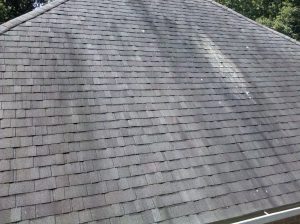 When it comes to houses, “shingles does not refer to the horrible illness that strikes people who’ve had the chicken pox, but to the flat rectangle that are laid overlapping one another.
Shingles can be made from asphalt, wood, or slate. You can also find shinglelike roofing materials made from clay tiles and even metal roofing. But the most typical shingled roof is made of asphalt. Asphalt shingles aren’t much to look at, but they’re cheap and easy to deal with.
They’re made from paper or fiberglass, which is then impregnated with various forms of asphalt and other metals to make it waterproof. Asphalt shingles are installed with nails, struck straight roof can last up to twenty years, which is a long time, but some other kinds of roofs will last even longer. The other issue with asphalt shingles is hat they tend to comes in dark colors which absorb heat and warm up the house.
Trick of the trade: heat is the biggest factor to consider when using asphalt shingles, which break down under the rays of the sun and in warm weather. For this reason, asphalt shingles are a better choice fro building structures in cooler, more cloudy climates.
Wood and Slate Shingles
Wooden roofs actually come in shingles and shakes. A shingle is a rectangular, flat piece that is precision cut. A shake is more roughly spit, more old-fashioned, organic look. Wood shingles tend to be made from cedar. Cedar shingles are a popular look in beach communities such as those on Long Island and in New England (think of Nantucket). You also find them in California, where there are beautiful trees to make them out of.
A good cedar roof, well tended, can last two decades. But be aware that it will rapidly evolve from a warm red-brown to a gentle, weathered gray. Wooden shingles come with holes precut into them and are nailed to the roof. The same is true of slate roofing. Slate is a naturally occurring stone that is mined all over the world. As well as here in the United States.
Slate comes in various colors and grade but is most typically a dark gray. Slate is expensive to both buy and install, but it lasts beautifully. A good slate roof can go more than fifty years. Slate is fireproof and waterproof and doesn’t need much maintenance, beyond replacing a shingle here and three each year. Slate is quite heavy, so you need to make sure you have a roof frame that can support.
Trick of the trade: Can’t afford slate shingles but like the look? Keep an eye out for synthetic ones that are dead ringers for slate and a lot cheaper than the real deal.
Clay Tiles and Metal Roofing
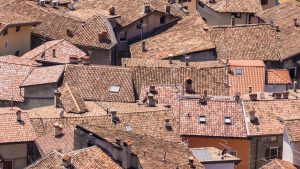 A clay tile roof is one os the oldest kinds of roofing out there. Think ancient Greece. Contemporary tiles can be made of clay (as they were in olden times) or of concrete. The tiles will come with holes punched in them and are nailed to the roof., although in some roofing systems not all of the ties are nailed down. Tiles offer many advantages.
They are durable, lasting more than fifty years if well maintained. They keep homes cool (which is why they are popular in places with warmer climates). And come in many styles, shapes, and colors. The upkeep is minimal. On the other hand, tile is a specific look that not everyone wants, and some tiles, particularly the curved ones, are also prone to being infested by animals.
High-end metal roofing, made from aluminum, steel, copper, and other compounds, is growing in popularity, and it is easy to see why. Metal roofing is lightweight and simple to maintain, reflects sunlight and heat away from the house, and it comes in many different colors and styles.
Unfortunately metal roofing is very expensive, more so even than slate in some instances. It can also be noisy. Imagine a night of listening to rain falling on a metal roof. These roofs do deteriorate over time, acquiring dents and ruts, and the paint can become chipped and peel. These problems are hard to fix without the help of a professional.

Alan Soucy administrator
About the author